

Which policies a community reads on your COI.
Four policies show up on service-company certificates. Here is what each one pays for, which one you need before you propose, and how to read the certificate your agent hands you.

General liability first, then whatever the community adds.
Left alone, a community asks for general liability. Workers’ comp, commercial auto and professional liability come up when a community adds them, and it can set a minimum limit on each.
General liability insurance
Pays when your work injures someone or damages their property. The each-occurrence limit, the general aggregate and the additional insured box are the first lines on the COI.
- General liability (commercial general liability, CGL) covers four kinds of claims a business can face: bodily injury, damage to others' property, personal injury including slander and libel, and false or misleading advertising.1
Sources (1)
- NAIC, as of
Workers’ compensation insurance
Pays medical bills and lost wages when one of your crew is hurt on the job. Your state’s rules decide whether your company carries it.
- Workers' compensation protects a business owner from the employer's statutory obligation to cover employees with a work-related injury or illness.1
Sources (1)
- NAIC, as of
Commercial auto insurance
Pays for accidents in the trucks and vans you drive to the job. Your general liability policy excludes vehicles.
- Commercial auto policies differ from personal auto: they carry higher liability limits and may cover rented and other non-owned vehicles.1
Sources (1)
- NAIC, as of
Professional liability insurance
Also called errors and omissions, or E&O. Pays when advice or a professional service you sold turns out wrong.
- Professional liability, or errors and omissions, covers wrongful practices by professional service providers.1
Sources (1)
- NAIC, as of
Limits are the most a policy will pay.
Each community sets its own limits when it writes an RFP.
Ask your agent for a COI that shows your actual limits.
- A policy’s limits are the most it will pay.1
- An occurrence is an accident, including exposure to conditions, that causes bodily injury or property damage neither expected nor intended from the standpoint of the insured, during the policy period.2
- An aggregate limit is the most a policy will pay for one loss or for several losses combined during the policy period, or on a single project.3
Commonly requested by managers and boards
Community associations’ own guidance names the coverage types below.
- CAI guidance for association maintenance and remodeling projects says a contractor's insurance should likely include construction, property and liability, workers' compensation and professional liability coverage.1
- CAI advises hiring a contractor or inspector who carries general liability without a homeowners association exclusion, plus errors and omissions where they act as a consultant.2
- CAI tells boards to get certificates of insurance for the contractor and, in some cases, additional insured endorsements naming the association, after consulting counsel.3
- CAI says to weigh the pros and cons of having the association named on the contractor's insurance.4
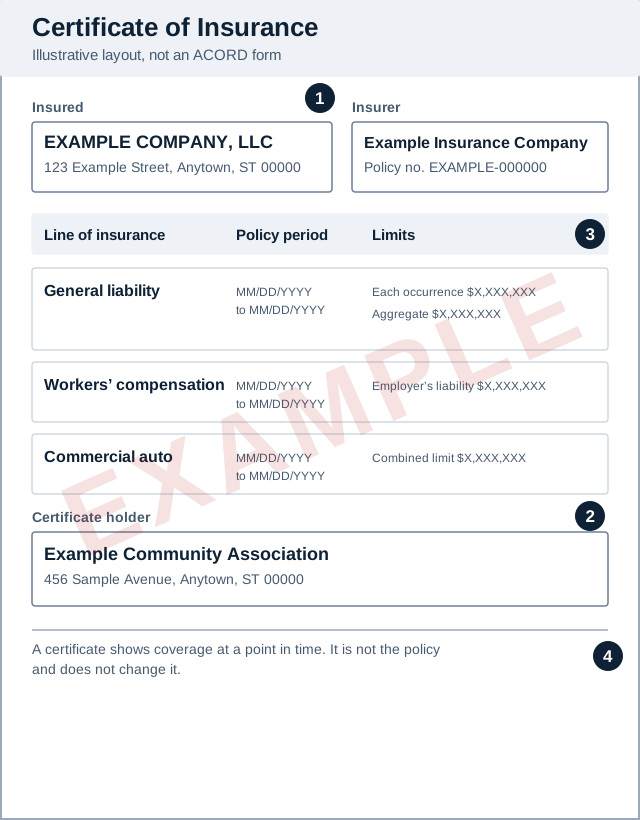
What a certificate of insurance shows.
These tabs cover what is printed on a COI and why holder and additional insured are two different boxes.
- A certificate of insurance is a document that provides information about insurance policies.1
- A certificate generally lists one or more lines of insurance, the limits for those coverages, and the insurer.2
- A policyholder gets a certificate from its broker or agent, not from ACORD.3
- The third parties who request certificates are called certificate requestors or holders.1
- A certificate gives the certificate holder no rights to the underlying insurance, and the holder is owed no duty of cancellation notice (Connecticut Insurance Department bulletin, Nov. 9, 2010).2
Sources (2)
- ACORD, as of
- Connecticut Insurance Department, as of
The definitions below come from state insurance regulators. Ask your agent how this works in your state.
- An additional insured is a person or entity the insurer adds to the policy as an insured at the policyholder’s request; a certificate holder is not the same thing (NY DFS opinion, Sept. 27, 2010).1
- A certificate does not make the holder an additional insured; that takes an Additional Insured endorsement, or being named an insured in the policy (Connecticut Insurance Department bulletin, Nov. 9, 2010).2
- In Texas, if the policy has only a blanket additional insured endorsement, the certificate cannot name the holder as an additional insured, though it may say a blanket endorsement exists.3
Sources (3)
- An endorsement is an amendment or rider to a policy that adjusts coverage and takes precedence over the general contract.1
Sources (1)
- NAIC, as of
Your agent or broker prepares your certificate. Use the link below for the form itself, since we don’t reproduce it.
- ACORD publishes a form called the ACORD 25, a Certificate of Liability Insurance.1
- ACORD describes the ACORD 25 as one of the most widely used forms in the insurance industry.2
- ACORD says it has published the standard forms used by the insurance industry since 1971.3
This sample follows the certificate layout agents use. Every name and figure on it is made up.
Ask your agent for the COI.
Your agent prepares the certificate, and you upload it from your checklist.